READ THE
FULL MAGAZINE
VIEW THE
PODCAST
Related Insights
Talent Acquisition
Trends 2026: Human-
AI Power Couple

HR Trends to Watch in 2026
International Pay Transparency & Pay
Equity Trends 2026
READ THE
FULL MAGAZINE
VIEW THE
PODCAST



Headlines paint discouraging prospects�for businesses and careers.
The problem
Too much gloom and doom stalls productivity and innovation.
why it matters
Corporate chiefs and workers�need to overhaul both leadership�roles and career advancement.
The solution
Job Openings Fall 50 Percent! CEO Exits Hit New Record! For more than a year, there’s been a
steady stream of tough news that would discourage anyone trying to lead a company or boost a career.
Here’s some of the brain and body science on what negative news does to us.
ure, there are private jets and high payouts. But CEOs at most firms struggle to keep their heads afloat. Executive whisperers report that nearly every CEO spends half of their Sunday meeting with their leadership team, and the other half catching up on memos and board papers. When they look at the news, they see headlines about new records being broken in CEO exits, both in 2024 and in 2025. And whether they are CEOs or not, most high-level leaders feel that they’re being bombarded with the unknown. Their survival depends on learning to cope with permanent disruption on an enormous scale, even as they’re under persistent pressure to drive quarter-over-quarter metrics.
Previously, executives oversaw change initiatives that might span three to five years—a timeline that now seems laughably long. Currently, one company in five is completely reinventing its businesses every 12 months, according to data from Accenture. Executives can no longer rest after completing a change process, says Lesley Uren, CEO of Korn Ferry Consulting. “Now there’s one change, then another wave, then another.” Most firms and executives are simply not designed to cope with those constant whitecaps of change.
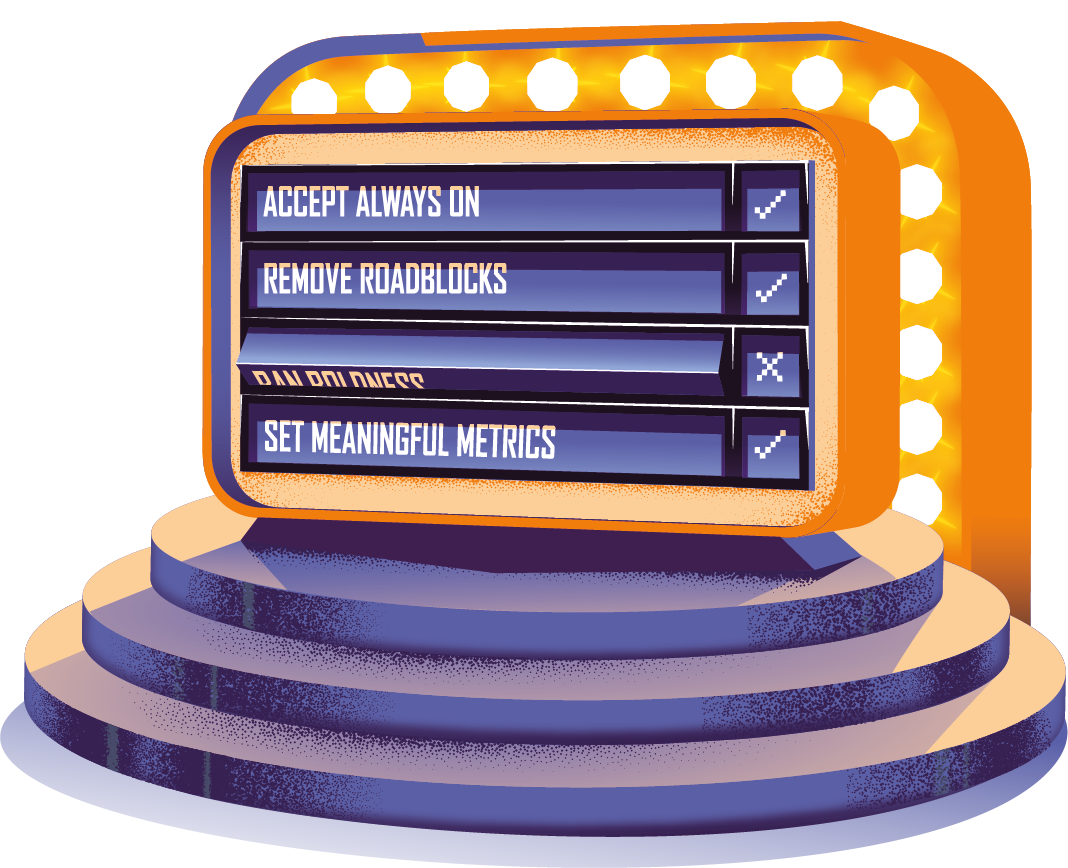
An entire industry has sprung up in recent years just to help leaders improve their outlook. CEOs have tried everything from scenario planning to pep talks to meditation. But what seems to be emerging as a viable solution, say experts, is to build a company with “always-on” capabilities. Under this model, a firm overhauling �its business plan is not reinventing itself, but simply responding quickly to the markets. It’s the new normal, and experts say that the path forward is not simply a C-suite training project, but an organization-wide shift to allow nimble responsiveness. That process requires removing the predictable roadblocks that prevent organizations from being agile. The good news—yes, there is good news in this article—is that “leaders and their staffs control all of those roadblocks,” says Jaime Maxwell-Grant, senior client partner in the UK and Ireland Consulting practice at Korn Ferry.
As leaders enter a new year, those following this strategy are clarifying their priorities. What are the top-line metrics on which the whole company needs to deliver? The handful of goals could include operational performance, innovation, or sales numbers. “If what people are working on isn’t one of the priorities, they probably shouldn’t be working on it,” says Maxwell-Grant. Firms can jump-start these priorities with a town-hall meeting every 10 weeks, highlighting a singular priority. Once set, the tactic is to activate at scale, which happens when leaders and managers focus on executing strategy. “That is their job, going forward,” says Maxwell-Grant.
In the past, experts say, traditional management revolved around oversight, delegation, and relationship maintenance. But in today’s hyper-competitive landscape, those
skills are table stakes. An execution-first mindset requires
managers to think less like supervisors and more like project
coordinators who translate high-level strategy into concrete,
actionable steps that teams can complete this week. Speed
is crucial. While you are reading this sentence, successful
companies have already moved to implementation.
The Bad News Bears
Whether you’re a leader or a climber, the deck
may seem stacked against you. We look for ways
you and your firm can thrive in the coming year.
Beat the odds
By Arianne Cohen / Illustrations by Tim Ames
Mental bandwidth shrinks.
Chronic, news-triggered cortisol can disrupt memory and mood regulation, leaving employees foggier, more
reactive, and prone to fatigue
and withdrawal.
Chronic media stress can elevate inflammation and anxiety, leading
to more headaches, sleep loss,
and stress-related absences.
Repeated negativity over-activates
stress and fear circuits, which in turn
dull brain pathways that respond to positive stimuli. This ultimately lowers drive, optimism, and the willingness
to volunteer new ideas.
Through mirror neurons in the brain,
which facilitate empathy with others,
one anxious coworker can trigger stress
in another co-worker—turning tension
into a team-wide drop in morale.
Talent Acquisition
Trends 2026: Human-
AI Power Couple
HR Trends to Watch in 2026
International Pay Transparency & Pay
Equity Trends 2026






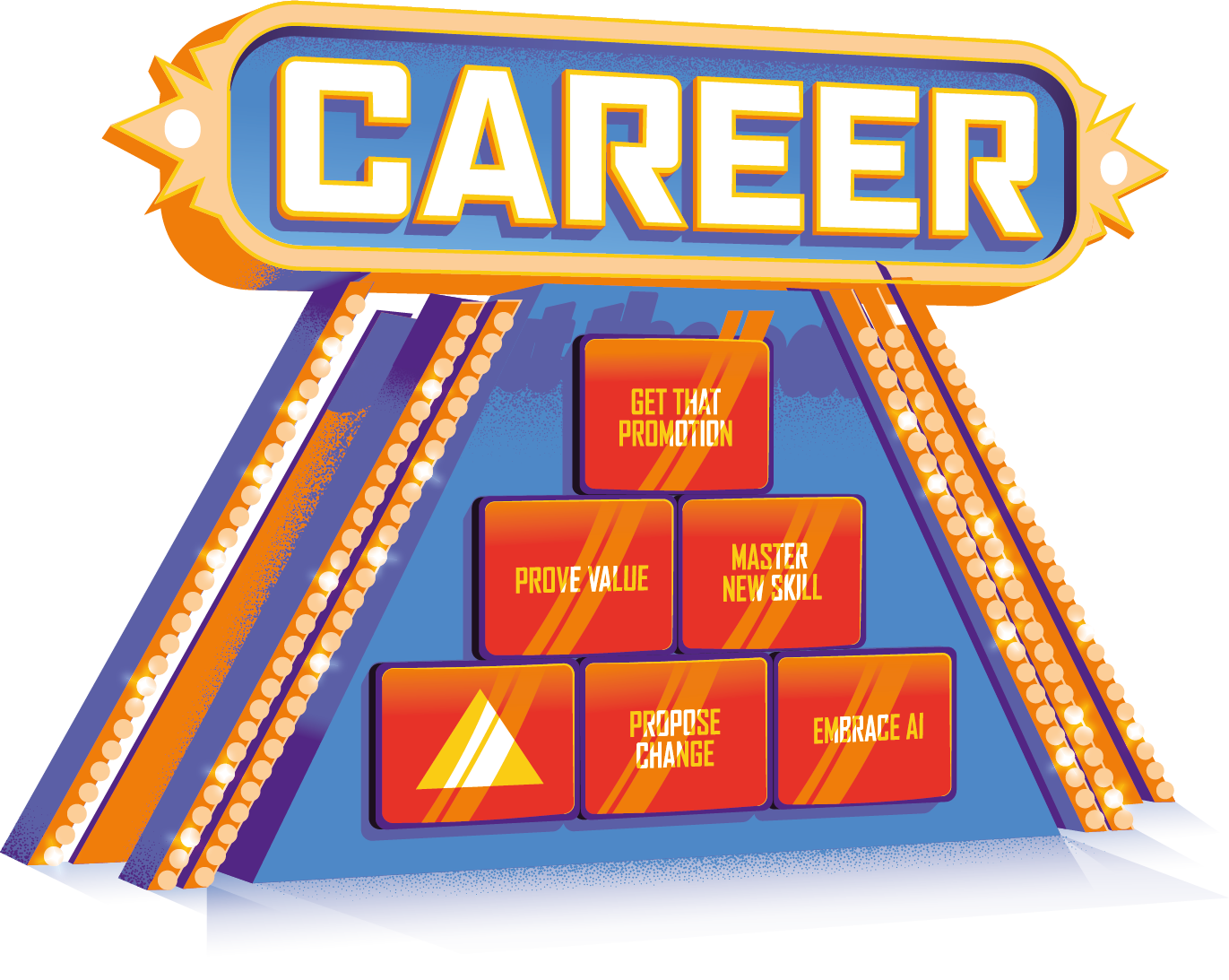
e used to know how to grow our careers, in good times or bad. But the old advice—network, overperform, get mentors—no longer guarantees a successful career. Gone are the days when snagging a job at a top firm was a golden ticket to a well-trodden path of career development and promotion. Constant change in the business environment is putting extraordinary pressure on firms to trim workforces: US job cuts are up 75 percent from 2024, with more than 800,000 layoffs through July 2025. Over the last ten years, sectors including retail, tech, and government have shrunk. Even high performers are clinging to their roles. Simply put, the skills you bring to the table are no longer enough to ensure job security.
The constant pressure of meetings and metrics is leading to a lack of attention to learning and development: One recent study of corporate supply-chain goals at 700 global companies found that 88 percent failed to mention people at all. Growth on the job is no longer handed out.
According to former CHRO Tim Toterhi, founder at career-coaching firm Plotline Leadership, there’s some good news: A worker can remain employed by demonstrating real value that goes beyond—ideally far beyond—the original scope of their job. One tactic is to become an employee who fills two roles for the price of one. Perhaps you’re a subject-matter expert who’s also the first to understand new tech and train colleagues on it. Or perhaps you’re a finance person who is also running HR for the finance and legal departments. “That makes you much more valuable—and, candidly, more difficult to replace,” says Toterhi
If multiple roles are not in the cards, experts say that some �employees secure their job by developing reputations as �specialists. Generalists are no longer viable. When a firm �needs an expert in production design or content marketing, �its leaders want to know who’s got the right knowledge �and background. “Unique and specific branding buys you �job stability when careers are chaotic,” says Toterhi. Fill �in the blank: I’m the person who’s awesome at _____.





Negative headlines tax the prefrontal cortex, reduce working memory, and
drain attention needed for focus, planning, and critical thinking.
Stress hormones spike.
Sick days rise.
Initiative drops.
Moods spread.
Few analysts foresee a long-term
market disaster, in part because
US retirement-account assets alone
exceed $40 trillion that needs to be invested. A strong market is a core provider of assets to business.
Wall Street
Resilience
The World Economic Forum is
predicting a net gain of 78 million
jobs by 2030, an indication that
tech and other global disruptions
can become a positive for the
labor force.
Net Job
Gains
Fears of job replacements may
be overblown: A 2025 Australian government report says that only
13 percent of jobs can be fully
automated by AI by 2050.
A Powerful
Tech Partner
Despite fear of rising prices, a
key economic survey sees global
growth holding steady at 2.9
percent in 2026.
Global Growth
Holding Up
Experts see AI boosting output
anywhere from 5 percent to 40
percent, depending on the role—
enough to finally give workers more breathing room for innovation
and special projects.
AI Can Create
‘Breathing Room’

Some indicators suggest a bit of optimism for corporate leaders �and career-focused workers in the New Year.
Five Facts, Five Reasons for Hope

ith the workplace resembling the Hunger Games, how can any manager, leader, or employee survive? Much of the workforce feels stuck, in one way or another. Yet “stuck” encapsulates a wide variety of scenarios, nearly all of which fuel stress and burnout, which is a formula for poor mental health.
For many, employee mental health may be a tired subject, with advice you can recite from memory: Get enough sleep, exercise more than you think you should, eat healthfully, quit the booze or cigs or pot. Yet burnout continues to mount: 44 percent of US employees report feeling burned-out, 45 percent are “emotionally drained” from work, and 51 percent feel “used up” at the end of the workday, according to a survey by the Society for Human Resource Management. Meanwhile, the number of people taking mental-health days has soared by 300 percent since the pandemic. Sure, supportive bosses and teammates buffer the stress, along
with robust corporate mental-health support. But no amount of massage benefits and soothing whale-sounds music in the restroom can counteract roles that require long hours with minimal autonomy. The fundamental problem, the pros will tell you, isn’t individual resilience.
Corporations are increasingly paying attention to job design—that is, creating positions in which workers can sustainably succeed, and remain energized and motivated, for years. The most progressive companies are redesigning roles to include natural recovery periods, meaningful decision-making authority, and clear boundaries between urgent and merely important tasks. Organizational-strategy experts now consider smart job design to be a core part of always-on companies: Amid intensive work, employees must be able to recover, feel in control, and achieve both their own and corporate goals. Firms are discovering that sustainable performance isn’t about pushing harder—it’s about designing systems that allow people to push smarter.
Those who are surfing the waves have come up with their own survival strategies. At Klatch Coffee, Perry reminds herself to play the long game. Klatch has been in business for three decades, and she’d like to see it
do three more. She’s laser focused on the details within her
control, which are primarily related to daily experience,
from cup feel to barista hospitality. This microfocus allows
her to find meaning and mastery in the midst of broader
uncertainty. “Whether it’s $5 or $10, it has to be a good
experience that they want to do again tomorrow,” she
says. “And me too.”

t’s hard to be a CEO in an environment of unremitting change. Especially if you are Heather Perry, CEO of Klatch Coffee, which is opening 20 new locations across Southern California. “It’s pretty wild,” she says. “There are ups and downs, and you never know what’s coming at you.” No, she’s not describing a theme-park ride—she’s describing her daily work.
A graph of coffee prices over the last year looks like an illus-tration of the Alps: The cost of beans has peaked and plunged repeatedly, largely due to an on-again, off-again tariff on Brazilian imports. Few domestic sources are viable since US bean output
is so small. But ultimately, such day-to-day challenges are not Perry’s greatest stressor. “Going to bed is the hard part,” says Perry. That’s when her mind plays through the scenarios that
keep making headlines: Will tariffs reverse? Will weather destroy the coffee crop? Will a social-media misstep emerge?
Bit by bit, gloom and doom seems to have become a permanent mindset for many business leaders. Sure, most executives have become accustomed to change, but what’s hard to stomach is



















matters largely beyond executive control these days. This,
while shareholder activism continues to hit record levels. In challenging weeks, leaders compose their “I’m quitting” speeches in the shower.
It’s not much better for workers, who face unrelenting headlines about an “impossible” employment market and find themselves clinging to their jobs in a way that has led to a new phrase: job hugging. High stress, extreme burnout, and financial insecurity concerns naturally follow. Engagement is now at a 12-year low, according to Gallup figures, and just 31 percent of employees
say they feel involved with and enthusiastic about their jobs.
Yes, it’s rough out there, even terrible, rotten, and treacherous. The odds certainly don’t favor many firms and groups as we plunge into 2026. But we had to ask: Does it have to be this way? Experts say executive outlook can be a state of mind, centered on looking for wins. So Briefings decided to go hunting for some key steps and strategic turnarounds that will help businesses and careers as we dive into a new year.
the steady drumbeat of incoming disruption that hangs over every corporate discussion and every Zoom call. Repeatedly, there is the talk of tariff-fueled inflation; AI, the once-in-a-generation technology that isn’t paying off yet; and unpre-dictable global shifts. According to the C-suite Stress Index
from insurer Sentry, some 47 percent of leaders cite economic volatility as a top concern, 44 percent point to supply-chain challenges, and 38 percent single out labor shortages—all